free powerpoint backgrounds templates
Free PowerPoint templates → backgrounds → presentations → downloads → blog → PowerPoint blog 

Friday, November 20, 2009
  Presenting with Twitter - Free Ebook

The Twitter backchannel is changing the way speakers deliver presentations. Twitter is also changing the way conference planners promote and manage events.

What do teachers, trainers, speakers, and conference planners need to know to keep up with these fast-breaking changes?

You can find out in a wonderfully written (and totally free!) ebook written by "Speaking About Presenting" blogger Olivia Mitchell. The comprehensive ebook, How to present with Twitter (and other backchannels) is available today for free download.

Presenting with Twitter ebook by Olivia Mitchell
My one-word review of this e-book?

"Wow!"

Olivia gave me the opportunity to review her ebook earlier this month. I was absolutely blown away by how thorough, enjoyable, and helpful her book is as a guide for preparing a presentation or event. Chocked with great tips, if you are planning a presentation, speech, or conference at the moment, here is my 4-step advice:
  1. Drop what you're doing.
  2. Visit Olivia's blog.
  3. Download & read this amazing 62-page book.
  4. Discuss -- how will the Twitter backchannel change the way you plan & present today?
PS - Be sure to follow Olivia Mitchell on Twitter @OliviaMitchell -- she's the engaging lady in New Zealand who frequently shares great ideas about presentation and speaking best practices.

Labels: ,

Wednesday, November 11, 2009
  How to Be a Great Audience Member

When I'm presenting live, I look for a friendly face in the audience. I like to focus on attentive, smiling, thoughtful faces. They give out a good energy that I respond to as a presenter.

Often, just one friendly audience member can make me a better, more confident presenter.

So when it's my turn to be an audience member, I try to pay the good audience vibe forward. I feel that a presenter will do a better job if someone in the audience gives the performer "good face". I try to radiate "positive face energy" to the performer. I make eye contact. I smile and nod at the presenter. If it's supposed to be funny, I'll laugh or giggle.

great audience membersI like to believe that if I'm a positive audience member, my face and energy will encourage the presenter to give a more enthusiastic performance.

Think about this the next time you're in a deadly dull presentation. We often hear or read about improving our "presentation skills" -- but what are we doing to improve our "audience skills?" How are we helping to co-create the presentation experience with the person who's on stage?

What part can we play -- as audience members-- to improve the performance of any presenter?

Labels:

Friday, October 30, 2009
  Halloween Meets the Fear of Public Speaking

Imagine getting this event invitation:

"Come to our Halloween party. Dress as your worst fear."

I received just such an event invitation a number of years ago. Delighted, I set my mind to the task of what I would wear.
"Worst fear. Let's see. I'll bet people will come as ghosts, werewolves, monsters, and such. But I'm not really scared of those things... what am I really afraid of?"

fear of public speaking
After a number of days of deep thought, I had my answer.

I went as Madame Butterfly.

However, when I got to the party, a gal dressed as a spider and a guy with a lightning bolt driven through his brain wanted to know if I was afraid of tall Japanese ladies.

I explained that the operatic heroine Madame Butterfly represented my fear of being abandoned and treated as a social outcast.

Perhaps this was too deep for my newly-found party compatriots, because they exchanged puzzled looks and walked away. But a fellow in a three-piece suit seemed to understand.

"Fear of success?" I questioned, looking at his get-up.

"Hey, I hadn't thought of that, but maybe," he admitted. "I was thinking about how much I fear the idea of becoming a corporate slave, locked in an office, and looking + acting + talking like an android for the rest of my life."


It seems that the fellow in the suit and I went a little too deep for a Halloween party, but at least our costumes were conversation starters. And they got us thinking about what we were really afraid of.

Perhaps the greatest gift of the "greatest fear" theme of Halloween was to get me thinking about my real fears. I embodied my fear. I literally wore it out of the house! I discussed my fear frankly in a public setting with strangers and friends, and poked fun at it.

Halloween can be a wonderful gift for facing fear.

Well, I don't know what became of my three-piece suit friend, but dressing up as Madame Butterfly weirdly helped me get over the fear of being a social outcast.

People often cite that public speaking is the greatest fear, but it's not. It's a myth. Hey, I didn't see anyone at the party dressed up as a public speaker -- you know, the ones on the circuit with the creepy Botox, amazing dental work, and buttoned-down business garb.

We all might be creeped out by these kinds of public speakers, but no one's really scared of public speaking itself. Not really.

They're scared of what happens as a result of public speaking. Like me, they might be scared of being a social outcast or ostracized for something they say (or how they say it.) They might be afraid (like my buttoned-down party pal) of sounding unnatural and inhuman.

Those are some of the real fears behind the myth of the fear of public speaking. The oft-parroted "fear of public speaking" myth prevents folks from addressing their real fears.

So it's Halloween.

Face your real fears. If you're an adult, you're not really afraid of zombies, monsters, ghosts, or public speaking. They're all just illusions.

What are you really afraid of? And how will you face it?
Friday, October 09, 2009
  Two Tips for Curing the "Trailing So..."

Americans find the word "whatever" annoying.

They find it way more annoying than the phrase "you know" and "it is what it is."

This factoid comes courtesy of USA Today, as quoted in a recent Marist Poll.

Really?

As for me, I have trouble with another pervasive verbal tic.

I call it "The Trailing So."

Ending Sentences with SOYou might hear "The Trailing So..." in interviews and Q&A sessions. Someone asks a question. The subject answers, but instead of ending the sentence in a period, he or she ends with "so..."

You can actually hear the ellipses after the trailing so! For example:
Question: "How did it feel to come back to Michigan after living in Hawaii?"
Answer: "Hawaii is great - beautiful weather. I like the change of seasons in Michigan, though. So..."
The "trailing so" signals a weak answer, or that the interviewee is too bored to complete the thought to a satisfying conclusion. It's often a sign that the mouth has started chattering before the brain has had time to think through the answer!

How to cure the trailing so. The first step to finding a cure for the trailing so is to become aware of it. If you find yourself ending a sentence in a trailing so, there are two common situations for why you might have let this verbal tic slip.

1. Habitual Offender. If you find that you're a repeat "trailing so" offender, it's likely that you have become accustomed to hearing it, and unconsciously let this sloppy habit slip into your vernacular. You'll do well to take a moment or two to think through your answer to completion before activating your voice. Taking these silent moments can make you look more thoughtful and reflective. It sure beats babbling around in circles while you try to figure out how you're going to end your statement!

2. Bored or Tired. Let's say you're giving an answer, and find to your horror, that you've ended with a trailing so. This is so unlike you, and you're mortified! You may have done so because you lost interest in your own idea halfway through your statement. Or you may simply be exhausted. At this point, snap awake and firmly state this phrase "Let me summarize!" After you say, "Let me summarize" - quickly and strongly finish your statement as quickly as possible.

For example, "Hawaii is great - beautiful weather. I like the change of seasons in Michigan, though. So...Let me summarize! I'm enjoying the difference!"

The best cure, of course, is to be aware of the trailing so -- and to avoid it by thinking through your statement before speaking.

What's your cure for pervasive verbal tics you find annoying?

Labels:

Friday, September 18, 2009
  Two Ways to Let Your Audience Co-Create Presentation Content

Your audience has the technology. They're carrying smart phones. They have net books or note books.

So why not let them use their snazzy tech tools to co-create presentations? Here are two tech-driven ways to let your audience co-create presentation content.

PollEverywhere. Audience interactivity is a big part of the draw of PollEverywhere. You ask your audience a question; they can answer using Twitter, text messages, or the web. The PollEverywhere online service instantly tabulates audience survey results in chart form in your PowerPoint presentation.

PollEverywhereI used PollEverywhere in class earlier this week -- it took me only a few minutes to craft a few cheeky surveys using the service. Downloading the poll as a PowerPoint slide (ppt or pptx) was a smooth, one-click operation. When students took the poll, results weren't exactly immediate -- I estimated a 15-20 second lag time before the graph started moving and changing before our eyes. Not bad at all.

PollEverywhere also allows you to ask open-ended questions as well as create bar or column charts. You may download survey results in CSV format, tweak colors and font sizes, and embed polls in web pages. This tool is very simple to use, yet fun and potentially quite powerful. Free for a small audience of 30 or less, PollEverywhere also provides more robust options with its paid services for use with larger audiences.

Twitter Hashtags. In the 1990's, I would often moderate candidate forums during election years. To keep these town hall meetings civil, we would pass out index cards and ask the audience to write out their candidate questions. Audience members passed their written questions to volunteers who made sure that the most popular and well-framed questions were brought forward to my lectern.

Today's audience may warm to a similar approach that is more transparent than using index cards. Why not ask a modern audience to Tweet their questions with a special Twitter hashtag for panel discussions? This lets a tech-savvy audience easily see the most popular and well-framed questions, while preventing boors from hijacking the Q&A portion of the program with tiresome or poorly-framed questions. Services like Tweetchat and Twitterfall let the panel and audience easily visualize the scope of questions surrounding the topic at a larger meeting, forum, or conference.

How else have you used technology to encourage audience interaction in your presentations? What works well? What doesn't?

Labels: , ,

Friday, September 04, 2009
  How do you EARN attention when presenting?

"No computers or handhelds during my presentation," barks a presenter. "I don't know whether you're playing games or paying attention. For the next hour, all eyes up here, on me!"

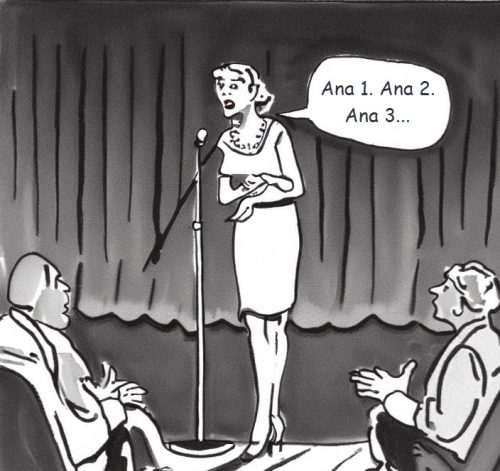
Olhos
Creative Commons License photo credit: Ana Marta 7

I ignore this insane outburst, of course. I'm an adult. So is the rest of the audience. I take notes on my notebook PC. If the guy has something pithy to say, I might even rock it out on Twitter, give him credit, and spread his idea further.

After his presentation, the fellow rebuked me for failing to follow his pre-presentation command. I was being rude by typing as he talked, he insisted.

On the contrary, I protested. I was there to learn from him, not to pacify his ego by staring adoringly at him while he ignored the needs of his audience.

In fact, I told him I glanced up from my computer numerous times. I looked at his PowerPoint slides, but the text was too small for me to read, so I looked at him. His body language -- back to the audience as he read the text from the slides -- didn't hold my visual interest, so my eyes went back to my computer screen. Because he was long-winded, he didn't give me any short concepts to Tweet, so his ideas didn't spread beyond the room.

I have an obligation to be a good audience member. It means that my mobile phone is silenced, so that I don't annoy others. It means that I give back energy to the presenter -- I laugh if something's funny, applaud if I am moved, nod quietly with agreement, raise my hand to ask questions, make eye contact at times, or participate in activities or discussions when I am asked courteously. Otherwise, I remain silent and take notes.

As a presenter, I note that my audience is often texting or typing while I talk. They might indeed be playing games or doing something non-work related. They also might be taking notes, learning, and sharing ideas.

It's not about me and my needs, it's about the audience. A modern audience uses modern tools. As a presenter, I need to learn to adapt my style to fit their needs. Why should the audience have to pacify my selfish needs for their attention? Why should I force my audience to stop using tools that let them learn and share information?

As a presenter, I need to EARN attention. If I'm interesting, the audience is more likely to be interested. They might express their interest in a different way: years back, they might have nodded and jotted down a note. Today, they might nod and type.

Get used to it. Don't churlishly tell your audience to PAY attention. Instead, be so phenomenally entertaining or interesting that they can't help but GIVE you their attention!

How do you EARN attention when presenting to a modern, tech-savvy audience?

Labels: , , ,

Monday, August 17, 2009
  Just Who Do You Think You Are?

"Just be yourself."

How many times have you heard this three-word bit of useless advice? Yes, you read that right: I wrote "useless". Why useless? Two main reasons:
  1. There's nothing "just" about being yourself. You're complicated. You're deep. If you were a rock or a piece of wood, perhaps you could "just" present yourself without thought to your audience.
  2. You can only be yourself. Even if you act as if you're someone else, you're being yourself. Apparently, you're an actor. Or a con artist. Hey, acting like someone else might be exactly who you are!
If someone tells you to "just" be yourself, you might think for a second, "OK, then -- who am I?"

cote Azur, France  1482

Creative Commons License photo credit: natamagat

You might find that you're rather complicated. You're a thoughtful, intelligent, caring person. You might also be a parent, a dog-lover, a teacher, a business person, a singer, a CEO of a thriving company, a practical jokester, a oenophile, a stamp collector, a martial arts expert, a gardener, a cook -- yes, indeed, you may be all this and more. Or you may be something else entirely...
"It is well known that people don't always 'speak their minds', and it is suspected that people don't always 'know their minds'."
-Quote from the Harvard Implicit Association Test Home Page
So, here you are. You're this fascinating and multi-faceted character, and some vapid goofball thinks you can "just" be yourself, as if you were a bit of plankton or an amoeba.

You can do better. Instead of just being yourself, why not present your very best self to the audience at hand?

For example, let's say you are a fabulous parent to two toddlers. That's a big part of "who you are". When you're with your children, you take on a tone of voice and project an image that is appropriate for your tots.

Now take that same tone of voice and image that you present to your children and use it to give a business presentation to the board of directors. Or lecture to a class of college students. Or to talk to the guy who's fixing your car.

Probably not so effective to be your "exceptional-toddler-parent" self for those particular audiences!

If you think you know yourself, think again. So let's go back to the very essence of "who you are" -- who are you, exactly? (For an eye-opener, I recommend taking some of the online tests at the Harvard Implicit Association Test. You may find out that you know yourself very well -- or maybe not!)

Let's say, for example, that you are "a thoughtful, intelligent, caring person."

No matter which role you take on -- parent, martial artist, teacher, business person, dog lover -- these characteristics describe the essence of "who you are". You carry these characteristics with you, regardless of the audience in front of you.

And because you are intelligent and caring, you might decide that your audience will be more enthusiastic if you decide to act like someone else entirely! Someone smarter, funnier, braver, stronger, sillier, dopier, goofier, angrier, more confident...whatever.

"Pretending to be braver than you are" is also a bit of presentation advice you'll often hear -- almost as much as that crazy bit about "being yourself."

If you have to pick between these two bits of contrary advice -- which would you choose?

And "just" how well do you know yourself-- really?

Labels:


>>> Contact Laura!

Laura Bergells on Facebook
RSS subscribers

SIGN UP FOR FREE EMAIL UPDATES:

Enter your email address:


...OR LET ME "FEED" YOU! PowerPoint blog 

AddThis Feed Button

Archives
07/03 / 08/03 / 10/03 / 11/03 / 12/03 / 01/04 / 03/04 / 04/04 / 07/04 / 02/05 / 03/05 / 04/05 / 05/05 / 06/05 / 07/05 / 08/05 / 09/05 / 10/05 / 11/05 / 12/05 / 01/06 / 02/06 / 03/06 / 04/06 / 05/06 / 06/06 / 07/06 / 08/06 / 09/06 / 10/06 / 11/06 / 12/06 / 01/07 / 02/07 / 03/07 / 04/07 / 05/07 / 06/07 / 07/07 / 08/07 / 09/07 / 10/07 / 11/07 / 12/07 / 01/08 / 02/08 / 03/08 / 04/08 / 05/08 / 06/08 / 07/08 / 08/08 / 09/08 / 10/08 / 11/08 / 12/08 / 01/09 / 02/09 / 03/09 / 04/09 / 05/09 / 06/09 / 07/09 / 08/09 / 09/09 / 10/09 / 11/09 /


Powered by Blogger

Subscribe to
Posts [Atom]

Online Videos & Podcasts

Bite Sized Internet Marketing Chunks