How to stop a boorish Q&A Hog in 3 easy steps

by Laura on March 9, 2011 · 23 comments

I recently attended a terrific, high-powered panel presentation that unfortunately became hijacked by what I’ll call “a Q&A hog.” You’ve probably witnessed a Q&A hog in action at a conference or presentation.

Q&A Hog, defined: an annoying creature that rambles incoherently during the Question and Answer period of a presentation. The hog typically takes up to 5 minutes to ask the presenter a very specific or off-topic question that no one in the audience has any interest in discussing. Q&A hogs usually have some personal agenda or simply love to hear the sound of their own voices.

The panel presentation I witnessed? The Q&A hog actually grabbed the floor mike and took over. It was a bad scene, man.

The hog held the entire audience hostage with non-stop rambling. The panelists and audience members started shuffling and checking their smart phones. The moderator looked wild-eyed around the room, vainly searching for armed gunmen with tranquilizers to shoot the beast down.
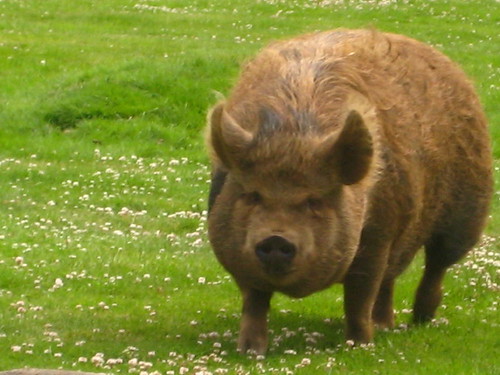
Q&A Hogphoto credit: Sheep Purple

Boors don’t pick up on obvious visual cues of disinterest. It’s not in their nature. They’re going to keep talking — until you shut them down. Mere body language and facial gestures won’t do the trick.

If you’re the speaker or moderator, you must shut down the hog.

And you must use words. Firm, direct words. It’s the only way.

Here’s a sample script you can try:

“Pardon, I’m going to cut you off. We have a limited time for Q&A. I want you to sit down and think about how you can ask your question in 30 seconds or less. Until you do, who else has a short question for me?” (Body language — scan the room with your arm raised.)

This direct method may seem harsh if you’re a sensitive sort. You may feel that you’re being rude to the hog. But you’re actually protecting and comforting your audience, which is far more important.

And actually, you’re not being rude to the hog at all. Unlike most people, hogs don’t seem to understand the “sit down and shut up” subtext of the above above script. Instead, many  seem to like the challenge: “What fun! I need to solve a puzzle! How am I going to reword my question to meet the time frame?”

You can try variations of the direct approach, but stick to three basics.

  1. Tell the hog you’re going to interrupt. Important point: never ask a hog if you can interrupt. Tell them that you’re cutting them off. If you ask “can I interrupt you?” — they’ll probably say “no, bear with me,  I’m almost done.” Then you’ll get 300 more hours of rambling incoherence.
  2. Align yourself with the audience. Remember, the audience wants the hog to shut up, too. By using the code phrase “limited time”, you’re signalling to everybody that unlike the bore, you respect their time. You’re going to honor and protect your audience.
  3. Move it along. “Who else has a short question?” while scanning the audience works wonders. During your scan, you will make eye contact with someone who is eager to shut down the hog, too. Giving this person ‘the nod’ is all the encouragement they need to get up and ask…anything.

I always recommend the direct approach for shutting down Q&A hogs. What’s your approach? What works for you?

{ 23 comments… read them below or add one }

1 Jody Meyer March 9, 2011 at 1:53 pm

I have also told the person that we can discuss this after the presentation.

2 Laura March 9, 2011 at 2:21 pm

Good one. I’ve pulled that one, too, Jody!

… but usually after I interrupt them and say something like, “This isn’t the best place for me to address your personal/specific issues. Why don’t you catch me afterwards? Who else has a question that I can address publicly?”

3 Scott Tanis March 9, 2011 at 2:33 pm

I also recommend imposing the 30 second time limit right off the bat. That way, it’s no surprise to anyone when you shut down the Q&A hog mid-sentence. Also, the Q&A hogs lined up behind them are hopefully already thinking about how they can pare down their questions. When you shut down the first person, the rest of them know that you mean it.

4 Laura March 9, 2011 at 2:38 pm

Excellent point, Scott. That’s a technique I intend to try out!

5 Dan Banta March 9, 2011 at 3:57 pm

Great thoughts here. Don’t run into this much with our GRAPE group (@GrapeGR), but when it has happened it is devastating to the time frame.

6 Laura March 9, 2011 at 4:06 pm

You’re right, Dan. The GRAPE folks are very courteous during Q&A.

Beyond devastating the time frame — no one likes being held hostage.

Moderators & speakers need to step up & protect the audience if they’re being hijacked by a bore!

7 John Rumery March 10, 2011 at 7:38 am

A lesson I learned many years ago….as the facilitator; never give up the microphone.

8 Karen Schofield March 10, 2011 at 7:43 am

I have to say, while I agree with closing the person down/moderating the person to protect the rest of the audience (and the time), I do think this particular turn of phrase (“I want you to sit down and think about how you can ask your question in 30 seconds or less. Until you do, who else has a short question for me?”) is very rude and condescending – I can’t believe you would actually advocate speaking to a colleague/other professional like that; if I did I certainly wouldn’t expect to be invited to present again! I think it is much better to just cut them off politely and say you can discuss at the end of the meeting – or any other technique which doesn’t sound like you are talking to a two year old!

9 Jeff Hurt March 10, 2011 at 8:53 am

Laura:

I agree that the person asking the question needs an intervention. Two ways I do this is:

1) Taking questions from the audience via direct text SMS or Twitter. Twitter questions have to be succint in 140 characters and that helps.

2) If there is not text questions, I interrupt like you do and with a slightly different twist. I say, “Excuse me. You obviously have a lot of passion about this topic and a lot to say. Let’s you and I discuss after the presentation together so I can learn more about your personally.” It does the same thing of shutting down the Q&A Hog…and with a little more aplomb that doesn’t fell so abrupt.

10 Laura March 10, 2011 at 8:54 am

Karen:

Far from rude or condescending, I’ve actually received cheers from an audience when using this approach. And quite a few planners have thanked me for shutting down their “repeat-offender” Q&A boors. The planners are in the position to invite me back — not the boors!

The “let’s discuss this afterwards” approach can only work if you actually want to meet privately with the person. Do you really want to have “alone time” with a stranger who publicly presents him or herself as a jerk?

If you don’t and say you do, you’re not being authentic. If you do, the audience pities and loses respect for you the second you say that you’re willing to reward a jerk they hate with a private audience.

Be polite, but be authentic. And be safe. Ask yourself if it’s really worth your own personal time and safety to meet with a stranger everyone — including you — thinks is a nut.

11 Laura March 10, 2011 at 9:10 am

Jeff:

I adore the Twitter approach. Using Twitter for Q&A has shut down many a Q&A hog before they can even begin to rant! I look forward to more conference organizers, moderators, panelists, and speakers proactively using Twitter to get & vet questions.

I’m leery about meeting privately with people who publicly present themselves as unhinged, though. I’d rather be publicly abrupt with them than privately plagued with vivid descriptions of their personal drama!

In short, I never say the equivalent of “I’d love to meet with you privately to hear all the scintillating details of your life. After all, I have nothing better to do and have scads of free time! All these other polite, interesting people in the audience? Screw ‘em. It’s you I’d love to meet!”

It sends a bad message, don’t you think?

12 Jeff Hurt March 10, 2011 at 9:38 am

Yes seriously I’d rather meet with you after my presentation. As a matter of fact one of those Q&A hogs ended up being a four year long client that paid me a generous amount of money.

13 Laura March 10, 2011 at 9:49 am

Jeff,

Yes, I’ve converted Q&A hogs into clients with private discussions, too.

But I tell you what — when I get a ‘deranged’ vibe from a guy instead of a ‘a little worked up & passionate’ vibe — I don’t second guess my gut!

I also scan the audience. If the guy is worked up and the audience is on his side, that gives me a cue, too.

14 Douglas Kelly March 11, 2011 at 8:08 am

Awesome post, Laura. I have had to learn this even for panelists in the last few months as I’ve moderated aimWest and GrapeGR events. It’s not just the Questioners that run long. It’s definitely not rude to interrupt someone that’s speaking too much. Everyone’s time is important. I’ve also responded to droning speakers from the audience that “validate” a panalist’s comment or speech, making it their own, by saying, “Was there a question there?”

15 Laura March 11, 2011 at 10:37 am

Thanks, Doug.

Next time, I promise not to drone on so much when I speak. Thanks for being there to stop me!

16 Fred E. Miller March 28, 2011 at 3:59 pm

Excellent advice, Laura!

A couple suggestions:
Have you Q&A BEFORE your Closing. The LAST Thing the audience hears is the First thing they will remember, and you don’t want it to be the Q&A Hog.

Tell the audience in your Opening and as you start the Q&A exactly how questions will be handled. Laying out the rules twice in and advance helps.

Thanks for the Post!

17 Sarah Khan July 20, 2011 at 1:38 pm

I, too, have had to deal with people like this when facilitating training sessions — that person who is well meaning but has to make a comment or share an anecdote about EVERYTHING you discuss. I’ve struggled during full day sessions sometimes to keep their comments under control because the sessions are supposed to be interactive. Due to my time commitments I can’t always stay afterward to discuss at length with anyone (nutter or not) so I always invite them to email me. That way I can also really think about my response without my emotions (ie: annoyance, anger) playing a part in the dialogue. Not everyone is a nut, but there are a lot of people who like hearing the sound of their own voice!

18 Viv Mcwaters January 2, 2012 at 1:53 am

Good advice, and I especially like the twitter option. And I’d like to offer another perspective. Don’t do Q & A. In fact, don’t do panels. When a client asks for a panel + Q & A I try and find out why they want that format. It’s usually some variation of the need to share as much information as possible from ‘thought leaders’ in an efficient and effective way. The internet now makes that redundant. Sometimes they don’t even know that other formats are possible. I like to take advantage of having the living breathing bodies in the room. Here’s what I’ve done instead. Invited the panelists to give a pecha kucha (6 mins 40 secs) or lightening talk (about 5 mins) and then invited the audience to connect directly with the speakers in smaller group conversations. If the audience is too large for that format, I’ll sometimes follow up with a world cafe lite process, and I always try and schedule long breaks (long = 45 mins or more for tea breaks, 90 mins or more for lunch) to allow people time to process the information they have received and to connect with each other and the speakers. Anything to break the habit of one-to-many processes.

19 Laura January 2, 2012 at 12:05 pm

Thanks, Viv. I’m feeling your vibe on the panels.

In November, we tried something similar to what you suggested. We did an entire event in the Fishbowl style.
http://en.wikipedia.org/wiki/Fishbowl_(conversation)

The event was very effervescent and highly rated. It leads me to wonder if panel presentations will become as dead as a dodo in a few short years.

Thank you for stopping by!

20 Erica March 22, 2012 at 8:46 am

The problem was right here “The moderator looked wild-eyed around the room”. Moderators are there to moderate.

When I run an event, I email moderators guidelines with specific tips for time and audience management, since I presume not everyone really has skill at this. In moderating panels for the last decade I have cut people off, sent them back to their seats, warned audiences what questions would not be taken, and challenged them to ask me good questions by bribing them with prizes.

The person leading the panel needs to lead…or get out of the way.

21 Laura March 22, 2012 at 9:42 am

Exactly so, Erica. Moderators need to moderate!

Lead or get out of the way…love it!

22 James Blake May 13, 2012 at 10:58 am

At the 2012 RISE Entrepreneurship Conference in Austin, Texas, Robert Rodriguez had a nice Q&A technique that he called the “shotgun method.” Basically he asked for three people to ask short questions before he would answer. His answer would hit on the questions that he thought most relevant or maybe just focus on the best answers that he had. This might not stop a Q&A Hog in the same context described in this post, but I thought it was a nice and subtle way to skip over non-relevant topics or annoying questions.

23 Laura May 13, 2012 at 1:58 pm

James, that’s a really great idea! “Shotgun Q&A that uses the power of 3″ — love it!

I may have to ‘steal’ that approach!

Leave a Comment

Previous post:

Next post: